- Lil' Signals
- Posts
- Lil’ Signals : Chaos vs Slow Culture
Lil’ Signals : Chaos vs Slow Culture
What happens when global anxiety spikes during Ramadan and Lent, and rituals become a bandwidth problem

Khalil El-Amin
March 04, 2026
👋🏾 Hey There!
Lil’ Signals is your go-to newsletter for decoding the cultural currents shaping our world. Powered by Nichefire, we break down trends, tell compelling stories, and share actionable insights on how to tap into the power of cultural listening.
Stay ahead of the curve, one signal at a time.
This week, I want to talk about a collision I can’t stop thinking about: the world speeding up into chaos, while millions of people step into two of the most structured seasons on the calendar, Ramadan and Lent.
And what it reveals about how humans actually cope.
Let’s dive in!!
Table of Contents

StoryTime
StoryTime: When the News Gets Loud, Rituals Get Practical
There’s a specific kind of anxiety you can feel in the air before you can explain it.
Not panic, not fear, something more ambient. Like a low vibration running under everything. You open your phone for one thing, and five minutes later you are deep in a thread you never asked for. You didn’t even choose the emotion, it chose you.
That’s what fast chaos does.
It turns the world into a constant update. A constant “breaking.” A constant sense that something is about to shift again, and you need to be ready, even if you have no idea what “ready” means.
And even if you are not glued to the news, you still absorb the mood. It shows up in conversations, in group chats, in the way people scan rooms, in the silence after someone says, “Did you see what happened?”
Fast chaos leaks into your body.
Now here’s what makes this week feel especially intense to me.
At the exact same time the world feels loud and unstable, millions of people are entering two seasons that require discipline, planning, and restraint: Ramadan and Lent.
And I want to be really clear about something: these aren’t “content moments.” They are not vibes. They are structure.
They are routines that ask you to make dozens of small decisions, every day, for weeks.
When do I eat?
What do I eat?
What counts?
What doesn’t?
How do I pace my day now?
How do I do this while still showing up for work, family, life?
How do I stay present when my brain keeps reaching for the chaos?
Ritual is beautiful, and ritual is work.
If you’ve ever tried to fast, or restrict, or live by a rule-set for a month straight, you know it’s not just spiritual. It’s operational.
Ramadan is a daily reprogramming. Your entire relationship with time changes. The day becomes a countdown, not in a stressful way necessarily, but in a structured way. Everything rearranges around suhoor and iftar, around energy levels, around patience, around community. You are managing hunger, yes, but you are also managing attention.
And Lent, for many people, is a different kind of discipline: a season of “no,” repeated often enough that it becomes its own rhythm. Meatless Fridays, giving something up, changing habits, reflecting, choosing restraint in a culture that rarely rewards it.
Both require planning, repetition, and mental effort.
Now layer the current mood of the world on top of that. The sense of instability. The feeling that something is always happening somewhere, and you should probably care, and if you don’t care you are guilty, and if you care too much you are overwhelmed.
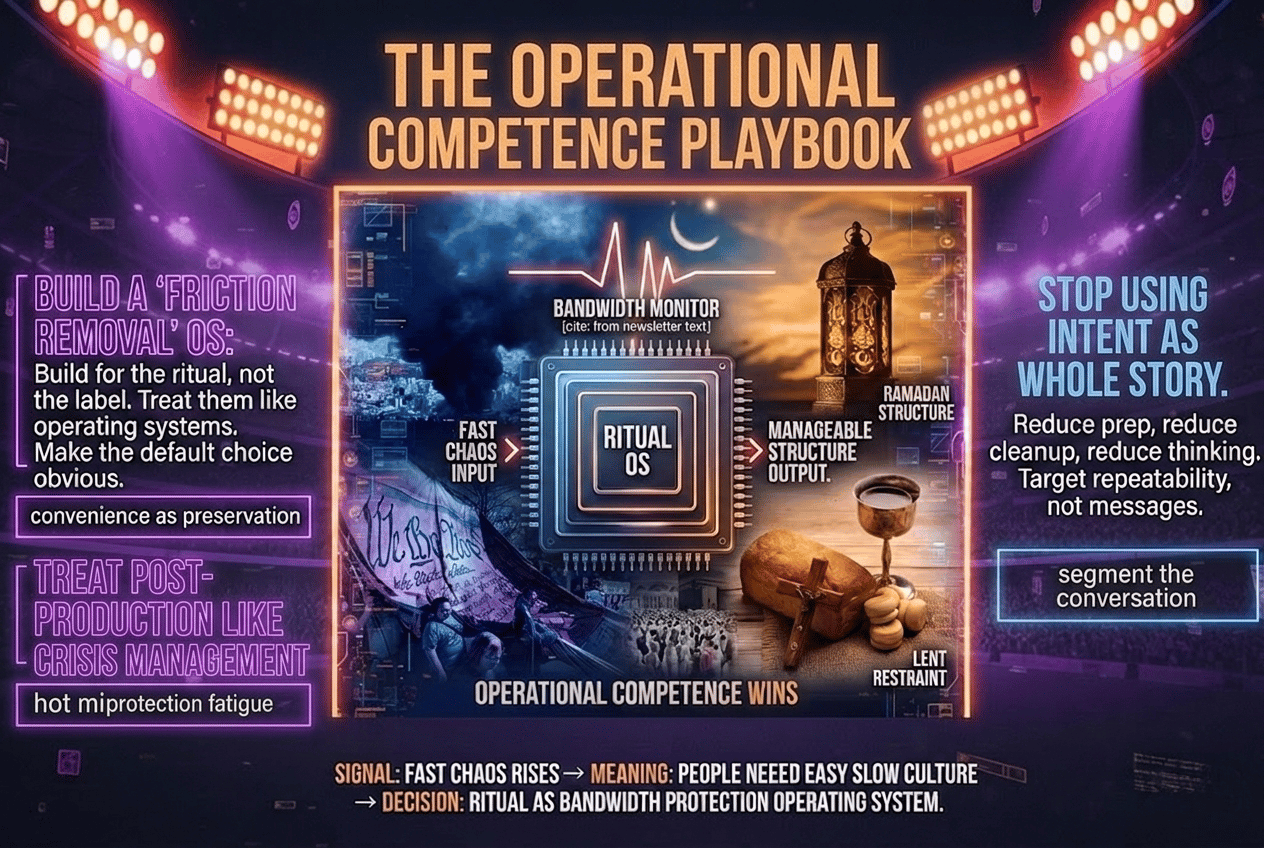
That’s when you start to see the real tension:
Slow culture asks for intention.
Fast chaos demands attention.
So when they collide, something has to give.
But what I’m noticing, and what I can’t stop thinking about, is that people aren’t abandoning ritual. They’re not discarding it like an old tradition that can’t survive modern life.
They’re redesigning it for survivability.
You can see it in the most ordinary places.
In grocery aisles where people are not just buying ingredients, they’re buying relief. They’re not asking, “What’s the best version of this?” They’re asking, “What’s the easiest version of this that still feels right?”
In the way meal planning content spikes around religious routines, not because people are trying to be trendy, but because they’re trying to reduce the number of decisions they have to make at 6 pm when they are tired, hungry, and emotionally spent.
In the way the language shifts.
It’s less “look at this feast,” and more “quick iftar ideas.”
Less “tradition,” and more “what can I eat.”
Less “perfect,” and more “what can I repeat.”
That language tells you everything.
People are trying to preserve meaning without burning out.
Because the hardest part of these seasons is not always hunger. It’s the cognitive load. The constant self-management. The small negotiations you have to have with yourself all day.
And when the world is already demanding emotional processing, that self-management becomes heavier.
So what happens is not that the ritual loses its value.
It becomes more fragile.
And that’s where the modern twist shows up.
Convenience starts to matter in a way that is not shallow.
Not convenience as laziness, but convenience as preservation.
Shortcuts that still feel respectful.
Defaults that reduce decision fatigue.
Meals that don’t require a full negotiation with your energy levels.
Options that make the ritual feel doable again.
That’s the signal:
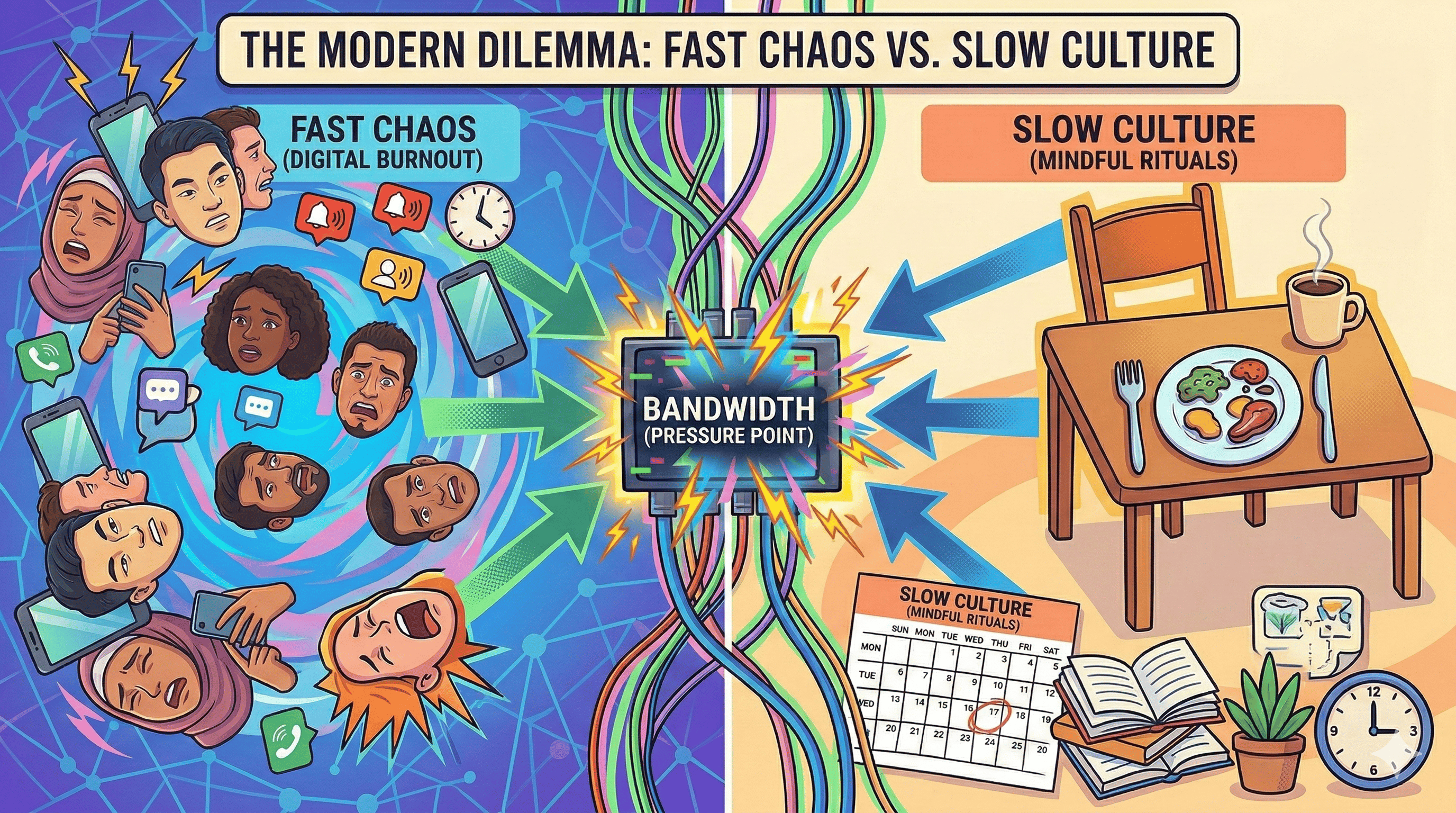
When fast chaos rises, people cling harder to slow culture, but they need slow culture to be easier to run.
Ritual becomes a buffer against the chaos, and manageability becomes the tool that protects the ritual.
So this moment isn’t just about Ramadan or Lent.
It’s about what humans do when the world speeds up beyond their capacity.
They don’t just look for comfort.
They look for structure they can actually maintain.
Key Insight
Ritual is becoming a bandwidth problem.
When global stress rises, consumers do not just want comfort. They want routines that reduce decision fatigue. They want structure they can actually maintain.
So the real opportunity is not “seasonal marketing.”
It’s friction removal.
The Playbook
Treat Ramadan and Lent like bandwidth protection seasons
Build for the ritual, not the demographic
Stop treating these moments like labels. Treat them like operating systems. The question is: what does someone need to keep the rhythm without falling apart?Make the default choice obvious
When people are tired, they pick the safest option. Your job is to become the safe option by making the decision simple and clear.Reduce prep, reduce cleanup, reduce thinking
Convenience is not laziness in moments like this. Convenience is preservation. If you can remove steps, you are removing stress.Design for repeatability
Weekly rhythms matter here. Friday meals matter. Sunset routines matter. If your solution cannot be repeated easily, it will not survive the season.Sell manageability, not messaging
If you are in CPG or QSR, do not lead with campaign poetry. Lead with usefulness. The win is: “This helped me keep the ritual without losing my mind.”
How to Use Cultural Listening Here
This is what fast chaos does to slow culture: it forces adaptation.
A practical workflow for catching that adaptation in real time:
Map the moment across channels: news mood, social search behavior, community posts, family routine content.
Separate the themes: devotion, convenience, affordability, health, guilt, pride, community.
Identify what people are optimizing for: time, energy, cost, confidence, tradition.
Track the friction points that repeat: “what can I eat,” “what’s allowed,” “I’m exhausted,” “quick meal,” “no prep,” “budget.”
Translate that into a simple build list: bundles, shortcuts, defaults, clarity.
The goal is not to predict culture perfectly.
The goal is to spot when people are patching their lives, and understand what patch they’re trying to install.
PS: Got a signal worth decoding? Hit reply or find me on LinkedIn or X.
Want the unfiltered version? Catch me live on Twitch.
Want the unfiltered version? Catch me live on Twitch.
Let’s explore the power of culture, one signal at a time.
Lil’ Surfing 🌊
Lil Surfing started as a catch-all: a place to stash the strange, funny, and culturally loud. And it still is, but now it’s powered by Firesearch.
Each week, I’ll be dropping a short culture scan: a peek into what’s bubbling beneath the surface, based on live searches from Nichefire’s system. You’ll still get the weird. You’ll just get it with a sharper edge.
This week, I ran a Firesearch on “Ramadan easy Iftar meals,” “quick Iftar meals,” “easy Iftar meals,” and “Lent Friday meals,” and here’s what surfaced:
Iftar is showing up as “family style,” not “quick content”
A lot of results weren’t just recipes, they were buffet specials, big platters, and meal ideas built for groups. That tracks, Iftar is often a communal meal, not a solo snack.
The shortcut economy is getting healthier
Alongside the traditional feast vibe, I kept seeing “healthy no-fry Iftar” and similar spins. The signal is not “people don’t want tradition,” it’s “people want tradition that feels lighter and easier to maintain.”
Traditional dishes are still the anchor, brands should learn the language
Biryani, samosas, pakoras, stuffed eggplants, this is the flavor universe people return to. The opportunity is not to westernize it, it’s to make the real thing easier to execute, especially for tired households.
Households are hybrid, and that’s the opening
Everyone’s not breaking fast the same way. In my house, my wife isn’t Muslim, I am, so I’m often breaking my fast with whatever she cooked that night. A simple, authentic kit, think “biryani + samosa vibes,” would make it easier for a lot of mixed or nontraditional households to participate without doing a full cultural deep dive.
Lent is not just “no meat Friday,” it’s practice
The surface-level play is “add fish.” The deeper play is understanding Lent as repeated restraint, people saying no for weeks. Families still need dinner, so the real question becomes: what supports the weekly rhythm, fish fries at home, baked fish defaults, frictionless Friday meal plans, not just one menu item.
Repetition is the real prize
30 days of Iftar routines. 40 days of Lenten discipline. That’s not a campaign window, that’s habit formation. If your brand becomes the default solution inside the ritual, you don’t just win a purchase, you get embedded.
🔗 Watch the live Firesearch walkthrough
💬 Got a theme you want me to run for a month? Reply with your pick.
💬 Your journey into the world of cultural insights starts here!
Thank you for being part of the Lil’ Signals community. Together, we’ll decode the world, one signal at a time.
Reply