- Lil' Signals
- Posts
- Lil’ Signals : Fast Culture vs. Slow Culture
Lil’ Signals : Fast Culture vs. Slow Culture
What McDonald’s Big Arch teaches brands about viral noise, consumer doubt, and the behaviors that actually drive sales

Khalil El-Amin
March 18, 2026
👋🏾 Hey There!
Lil’ Signals is your go-to newsletter for decoding the cultural currents shaping our world. Powered by Nichefire, we break down trends, tell compelling stories, and share actionable insights on how to tap into the power of cultural listening.
Stay ahead of the curve, one signal at a time.
This week, I want to talk about a trap I see brands fall into over and over again: mistaking fast culture for the whole story.
They see a meme, a viral video, a celebrity clip, or a brand pile-on, and assume the win came from speed alone. But most of the time, fast culture only creates attention.
Slow culture is what creates results.
And few recent examples show that better than McDonald’s and the Big Arch.
Let’s dive in!!
Table of Contents

StoryTime
StoryTime: McDonald’s Let the Internet Laugh, Then Let the Register Answer
There’s a specific kind of mistake marketers make when they spend too much time online.
They start believing the internet is the market.
Not a reflection of it.
Not an amplifier of it.
Not a distorted funhouse mirror of it.
The market.
So when something goes viral, they assume the virality itself was the strategy.
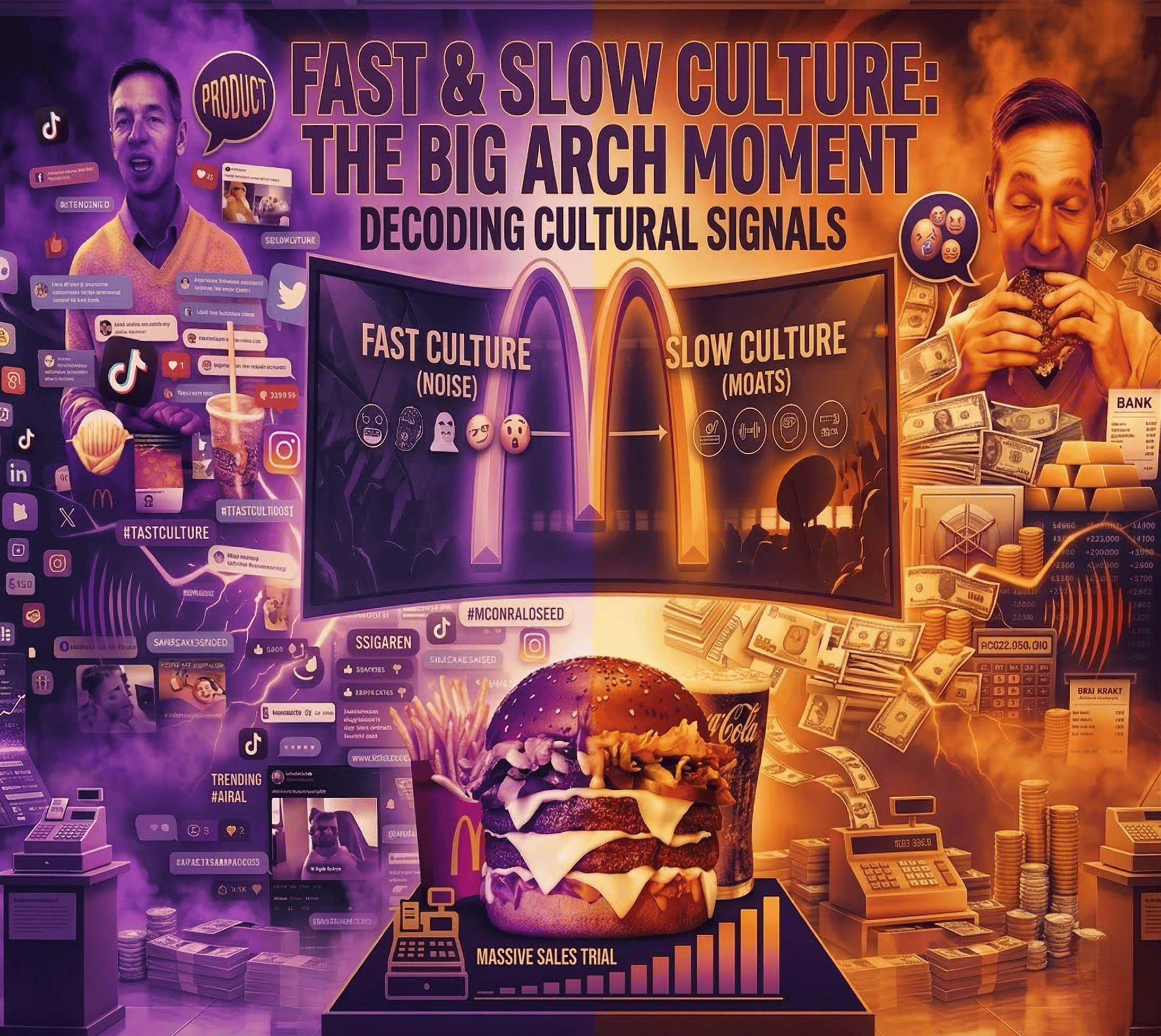
That is what made the McDonald’s Big Arch moment so interesting to me.
On the surface, it looked like a familiar fast culture story.
The CEO takes an awkward bite.
The internet notices.
People clown the way he says “product.”
The comment sections fill up.
Rival brands jump in.
Everyone gets their jokes off.
And if you stopped there, you would walk away with the wrong lesson.
Because McDonald’s did not win because the internet loved the moment.
McDonald’s won because the internet reacted exactly the way the brand likely knew it would.
That is the real story here.
For years, people have carried this baked-in tension around McDonald’s. Not just around taste, but around authenticity.
McDonald’s is one of the most recognizable food brands in the world, but it also carries decades of cultural baggage. People joke that it is not real food. They joke that executives do not actually eat it. They joke that the glossy ad version and the real-life version are never the same.

So when the CEO takes a bite on camera, the audience is not watching neutrally.
They are watching through a belief system.
If the bite looks too small, that becomes proof.
If the reaction looks stiff, that becomes proof.
If the language sounds corporate, that becomes proof.
That is confirmation bias doing what confirmation bias does.
Then social media does what social media does: it multiplies that reaction by putting thousands of people with the same assumptions into one giant public feedback loop.
What looks like a scandal is often just a belief getting community validation.
That is fast culture.
But underneath that fast culture reaction was a much slower cultural truth: McDonald’s understands the tension around its brand better than most people talking about it do.
That is what made this moment powerful.
The pile-on was not separate from the launch.
It became part of the launch.
All the jokes, all the reactions, all the competitor content, all the “there’s no way he eats that” energy only did one thing at scale:
It kept McDonald’s at the center of the conversation.
And because the Big Arch was tied to an actual consumer behavior, indulgent fast food trial, not just empty internet chatter, the attention had somewhere to go.
That is the difference.
Fast culture got people talking.
Slow culture gave that attention somewhere to land.
That is why this was not just a meme moment.
It was a commercial moment.
The launch estimates attached to this moment are massive, with projections ranging from roughly $180 million on the low end to more than $500 million on the high end for first-month systemwide sales, with the middle band looking especially plausible given the scale of the attention around the launch. And the beauty of it is this: a lot of brands joined the conversation thinking they were stealing the moment, when in reality they were helping McDonald’s extend it.
That is what happens when you confuse participating in culture with owning the behavior underneath it.
McDonald’s did not just move fast.
McDonald’s understood the slower truth underneath the noise.
And that is why they won.
Key Insight
Fast culture creates noise. Slow culture creates moats.
The Big Arch launch is a perfect reminder that viral moments are not valuable just because they are viral.
They are valuable when they connect to something deeper:
A routine.
A shopping mission.
A belief.
A consumer tension.
A behavior that already exists and is ready to be activated.
Fast culture is the expression.
Slow culture is the infrastructure.
Fast culture is the joke, the meme, the clip, the comment section, the brand response, the remix.
Slow culture is the long-running emotional and behavioral system underneath it. It is the pattern that keeps showing up before and after the meme disappears.
In McDonald’s case, the slow culture layer was clear:
People have longstanding skepticism about the brand.
People also still use McDonald’s as a familiar, convenient, indulgent choice.
People may mock the brand in public and still buy it in private.
People often use social chatter as validation before they try something themselves.
That is the lesson.
The meme was not the moat.
The moat was the consumer tension.
The Playbook
How to tell the difference between a fast culture moment and a slow culture opportunity
1. Separate the expression from the behavior
Do not stop at what is going viral.
Ask what behavior the viral moment is sitting on top of.
The clip is not the strategy.
The reaction is not the strategy.
The real question is: what existing habit or tension is this moment activating?
2. Look for the belief system underneath the comments
Comments are rarely random.
They are usually people revealing the story they already believe.
In this case, the audience was not just reacting to one bite. They were reacting to years of assumptions about McDonald’s, food quality, corporate polish, and authenticity.
That is slow culture talking through fast culture.
3. Do not treat skepticism like automatic failure
Not all negative attention is equal.
Sometimes skepticism is a sign that you are sitting on a live cultural wire.
If the doubt is connected to a real consumer behavior, curiosity, trial, comparison, indulgence, then the skepticism may actually be helping distribute the product story.
4. Tie the moment to a repeatable consumer routine
If the viral moment does not connect to a real-life decision, it usually dies as entertainment.
If it connects to a familiar decision, lunch, snack, trade-up, trial, impulse purchase, convenience, it has a path to revenue.
That is where brands need to focus.
Not just on whether people are talking.
On whether the talk changes a decision.
5. Let fast culture accelerate, but never let it lead
Fast culture is an accelerant.
It can amplify.
It can distribute.
It can intensify.
It can shorten the path from awareness to trial.
But it should not be your foundation.
If you build your strategy on fast culture alone, you are building on weather.
If you build it on a real behavior shift, you are building on ground.
The Translation Test
Before your team chases the next viral moment, ask these three questions:
1. What behavior is changing?
Are consumers trying more products through social validation?
Are they using internet chatter as a trial trigger?
Are they relying on memes and comments to decide what is worth trying?
2. What is it replacing?
It is replacing the old model where brand messaging alone controlled the launch story.
Now the public helps write the launch in real time.
3. What decision does this change?
Does it make someone try the product?
Does it make them talk about it?
Does it make them remember it at the point of purchase?
Does it make your brand more culturally legible next time?
If the answer is no, you are probably looking at a detour, not a strategy.
How to Use Cultural Listening Here
This is where brands need to stop tracking only the loudest conversation and start decoding the deepest one.
A practical workflow looks like this:
Map the moment across channels
Do not just look at social virality. Track social posts, comment themes, search behavior, brand responses, and consumer language patterns together.
Separate fast reaction from slow meaning
The meme is one layer.
The belief underneath the meme is another.
You need both.
Identify the recurring tension
In McDonald’s case, the repeated tension was obvious:
real food versus fake food,
corporate performance versus authenticity,
mockery versus trial,
skepticism versus convenience.
Track what people actually do next
Did curiosity rise?
Did product searches rise?
Did competitor comparisons rise?
Did the moment move people closer to a purchase decision?
Build for the long signal, not the loud signal
The goal is not to become amazing at reacting to every internet moment.
The goal is to know which moments are sitting on top of real consumer infrastructure.
That is where the real leverage lives.
Final Signal
Most brands think winning culture means moving faster.
McDonald’s shows that the bigger win is understanding slower.
The internet laughed at the Big Arch moment.
But the laughter was never the point.
The point was that McDonald’s understood the cultural tension around its brand, knew the reaction would come, and had a product sitting inside a real consumer routine when it did.
That is why the moment mattered.
Fast culture got them talked about.
Slow culture got them tried.
And that is a lesson a lot more brands need to learn.
Want the unfiltered version? Catch me live on Twitch.
Let’s explore the power of culture, one signal at a time.
Lil’ Surfing 🌊
Lil Surfing started as a catch-all: a place to stash the strange, funny, and culturally loud. And it still is, but now it’s powered by Firesearch.
Each week, I’ll be dropping a short culture scan: a peek into what’s bubbling beneath the surface, based on live searches from Nichefire’s system. You’ll still get the weird. You’ll just get it with a sharper edge.
This week, I ran a Firesearch around the Big Arch, the CEO taste-test moment, reviews, and burger comparisons. Here’s what stood out:
The comments looked negative, but the interest was huge
The reaction made the moment feel like a disaster, but search behavior said the opposite. Interest around the Big Arch, reviews, and burger comparisons surged. The mockery did not kill curiosity, it increased it.
The pile-on helped McDonald’s more than competitors
When other brands jumped in, they were not stealing the moment. They were feeding it. They may have earned engagement, but McDonald’s kept the attention.
The deeper story was McDonald’s brand baggage
People did not come into that video neutral. They came in with years of assumptions about fake food, overprocessing, and authenticity. The video did not create that story, it activated it.
Fast culture exposed the slow culture underneath it
The clip, jokes, and brand responses were all fast culture. What gave the moment legs was the slower public tension around what McDonald’s represents.
The real metric is not impressions, it is trial
The key question is not whether the post got engagement. It is whether people bought the burger. That is where this moment gets interesting.
My takeaway: this felt more calculated than people think
The video was awkward, yes. But McDonald’s is too culturally aware not to understand the reaction it would trigger. I think they used that awareness to turn a fast moment into commercial momentum.
🔗 Watch the live Firesearch walkthrough
💬 Got a theme you want me to run for a month? Reply with your pick.
💬 Your journey into the world of cultural insights starts here!
Thank you for being part of the Lil’ Signals community. Together, we’ll decode the world, one signal at a time.
Reply