- Lil' Signals
- Posts
- Lil’ Signals : If You Felt Something, That Was the Data
Lil’ Signals : If You Felt Something, That Was the Data
What a Puerto Rican Headliner, an American Sport, and a Polarized Audience Reveal About the State of Culture in 2026

Khalil El-Amin
February 11, 2026
Hey there 👋🏾
Lil’ Signals is your go-to newsletter for decoding the cultural currents shaping our world.
Powered by Nichefire’s cutting-edge technology, we break down trends, tell compelling stories, and share actionable insights on how to tap into the power of cultural listening.
Stay ahead of the curve, one signal at a time.
Today, we’re fresh off the Super Bowl, and I want to talk about what happens after the confetti: the conversations.
Because the game ends, the lights go off, and then the real event starts. Group chats. Timelines. Think pieces. The “did you see that?” that turns into “what does this mean?” in about 30 seconds.
Last week I wrote The Halftime Mirror to explain why halftime is no longer just a show. It’s a live cultural negotiation disguised as entertainment.
This week, I want to go one layer deeper.
Let’s dive in!!
Table of Contents

StoryTime
StoryTime: The Translator’s Burden
I grew up learning how to read a room before I learned how to win one.
I’m from Roselawn in Cincinnati, Ohio. The neighborhood itself was predominantly Black, and at the same time there were still layers around it, including some leftover Hasidic Jewish families in the area and a strong Jewish community next door in Amberley Village.
So the influence was there, but the real petri dish, the place where everything actually mixed, was school.
At that time, Roselawn had the largest magnet school, and it wasn’t only big, it was active. It pulled kids from different neighborhoods, different backgrounds, different family structures, different economic situations. And it also served students with physical and mental disabilities, meaning the mix wasn’t just about race or religion, it was about how people moved through the world, how people learned, how people communicated, and how people needed support.
So in one building, you had every kind of student: different abilities, different learning styles, different needs. That environment taught me fast that compassion is not optional if you want to understand people.
Then I’d go home and feel like an outsider in a different way.
Because I was raised Muslim, but most of my family was Christian.
My dad’s brothers and sisters weren’t Muslim. My grandmother was a devoted Seventh-day Adventist, so Saturdays meant church with her, learning how to move respectfully in that space too. Meanwhile, in my own house, Islam shaped our rhythm. No pork. Prayer. Ramadan fasting. Discipline.
So I was always translating.
At school, translating between my peers’ worlds.
At home, translating between faiths and expectations.
Socially, translating what it meant to be accepted without shrinking myself.
Then life added another layer: I’m a big man. I’ve always been big. When you’re 6’5” and 350, you learn quickly that your presence speaks before you do. So I learned compromise early, not the kind where you hide yourself, the kind where you learn how to meet people with awareness because you want them to meet you the same way.
That’s why I approach culture with acceptance first.
Not because I agree with everybody. Not because I’m trying to be neutral. But because I’ve lived long enough knowing that people’s realities can be wildly different, and still real.
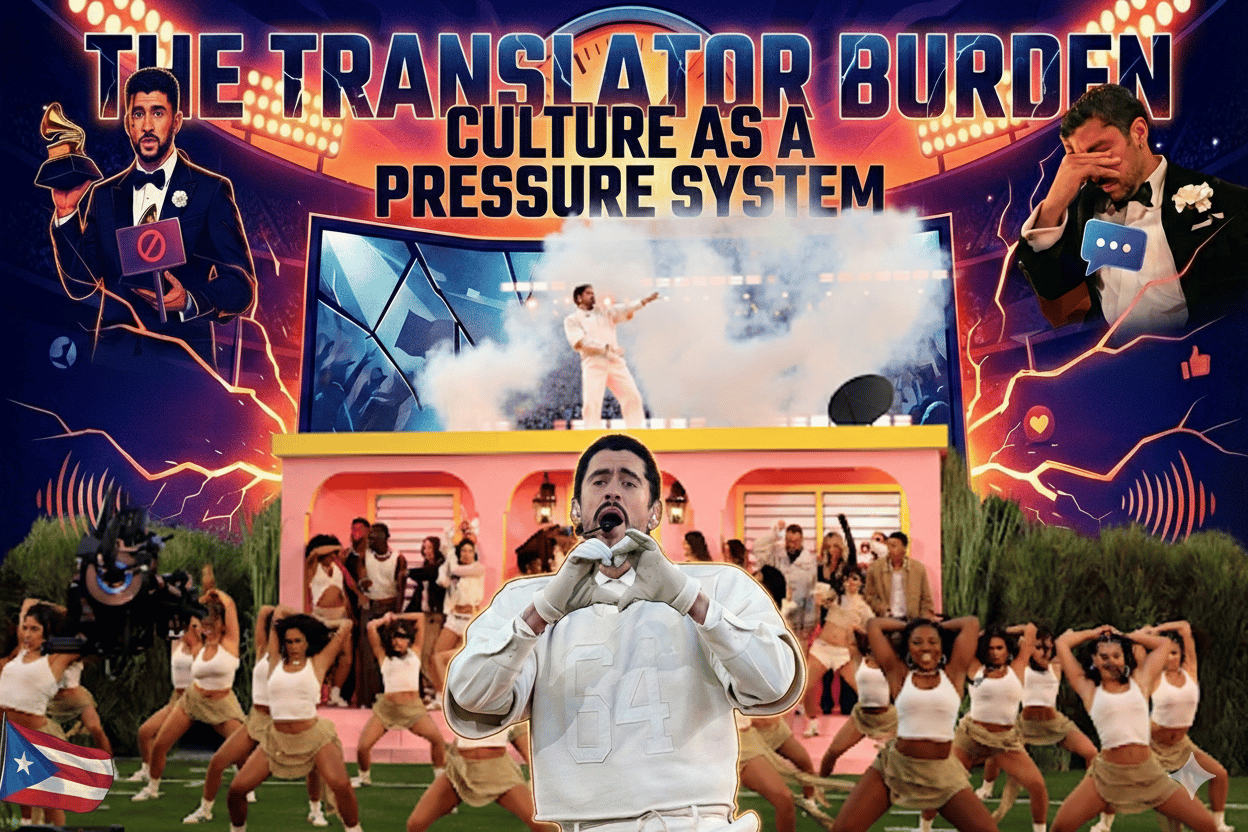
And that’s exactly what I saw in Bad Bunny’s halftime performance.
People keep trying to reduce it to entertainment or controversy. To me, it was neither.
It was translation.
He could’ve used that stage to swing hard, to lean into anger, to make it confrontation. Plenty of people would’ve understood why. Instead, he led with joy. He led with community. He created an experience that felt like pride without punishment.
And what stood out to me most was simple:
You didn’t need to speak Spanish to feel it.
My family watched together. We’re not fluent. We’re not “inside” the culture in the way some viewers are. But every person in the room could feel the energy. Love has a frequency. Joy has a frequency. You can catch it through a screen.
That’s the signal.
Not that everybody agrees.
That the emotional direction of the moment leaned toward inclusion, and the reaction proved something a lot of people forget when the internet gets loud:
The loudest voices are not always the majority. Sometimes they’re just the loudest.
The framework: Signal, meaning, decision
Here’s where I want to take this beyond commentary, because this season of Lil’ Signals is about moving from “here’s what happened” to “here’s how to move.”
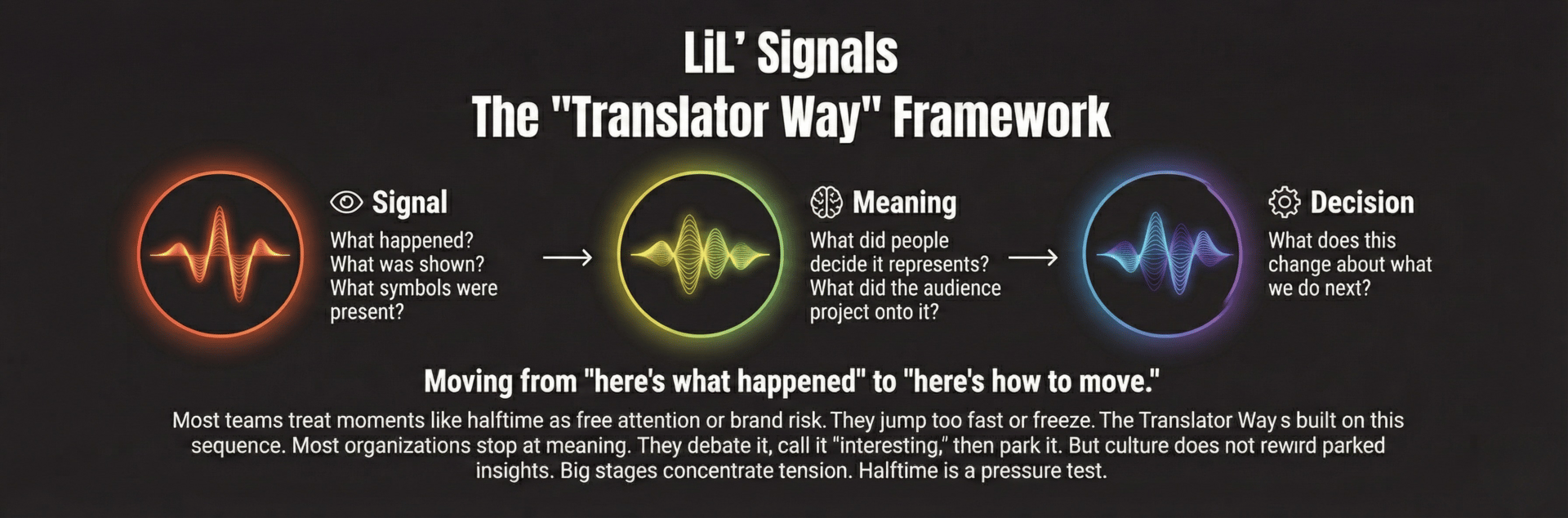
Most teams treat moments like halftime as one of two things:
free attention
brand risk
So they either jump in too fast, or freeze completely.
But there’s a third way, the translator way. And it’s built on a simple sequence:
Signal → Meaning → Decision
Signal: What happened? What was shown? What symbols were present?
Meaning: What did people decide it represents? What did the audience project onto it?
Decision: What does this change about what we do next?
Most organizations stop at meaning. They debate it. They call it “interesting.” Then they park it.
But culture does not reward parked insights.
Big stages don’t invent tension, they concentrate it. They compress all the underlying stuff into one moment and force everybody to react in public.
That’s why halftime has become such a reliable cultural diagnostic.
It’s a pressure test.
The translation: How to move without getting played
If you work in insights, brand, strategy, innovation, or leadership, here’s the decision logic I’m pulling from this moment:
1) Emotion is the leading indicator
Volume matters, but energy matters more. Joy travels. Pride travels. Fear travels. Outrage travels too, but it burns fast and collapses. The most useful question isn’t “how many people talked?” It’s “what did it make people feel, and what did that feeling make them do?”
2) Representation is not optional, but it’s still misunderstood
This isn’t about checking boxes. It’s about who feels seen, and who feels threatened by other people being seen. That tension is part of the environment now. The job is not to wish it away. The job is to understand it clearly.
3) Cultural fluency is becoming a form of participation
After big moments like this, people don’t just react, they signal belonging. They share clips, learn phrases, explore playlists, download language apps, argue about symbolism. Cultural participation is behavioral, not just ideological.
4) Brands that wait for consensus arrive late
Culture rarely hands you a moment where everyone agrees. If your internal process requires unanimous comfort, you will only act once the moment is over.
This isn’t about taking a side.
It’s about recognizing the environment you’re operating in.
Culture isn’t vibes.
It’s infrastructure under stress.
And the translator role, the one that can sit inside complexity without panicking, is becoming executive-level value.
Want the unfiltered version? Catch me live on Twitch.
Let’s explore the power of culture, one signal at a time.
Lil’ Surfing 🌊
Lil Surfing started as a catch-all: a place to stash the strange, funny, and culturally loud. And it still is, but now it’s powered by Firesearch.
Each week, I’ll be dropping a short culture scan: a peek into what’s bubbling beneath the surface, based on live searches from Nichefire’s system. You’ll still get the weird. You’ll just get it with a sharper edge.
This week, I ran a Firesearch on “Super Bowl LX Halftime Show” and here’s what surfaced:
Joy as Defiance, Not Escape: Conversation clusters are framing the performance less as entertainment and more as symbolic leadership. In a climate heavy with immigration anxiety and identity tension, celebration is being interpreted as resistance. The signal is not that halftime was political. It’s that joy itself is being read as a position.
Neutrality Is No Longer Invisible: Firesearch shows repeated linkage between the halftime performance and broader political discourse, especially around ICE, immigration, and national identity. The takeaway is not that the artist “made it political,” but that the cultural climate collapses the distance between entertainment and policy. Silence, celebration, or critique all register as stance.
Cultural Belonging Is the Real Battleground: The dominant narrative pattern centers on who felt seen versus who felt displaced. The conversation is not about choreography or set design. It’s about space. Who gets it. Who shares it. Who feels it is no longer theirs. That tension is driving the intensity of reaction more than the music itself.
🔗 Watch the live Firesearch walkthrough
💬 Your journey into the world of cultural insights starts here!
Thank you for being part of the Lil’ Signals community. Together, we’ll decode the world, one signal at a time.
Reply